I have been preparing something special.
It has been quietly taking shape for a while now, and it comes from a frustration I have had for years.
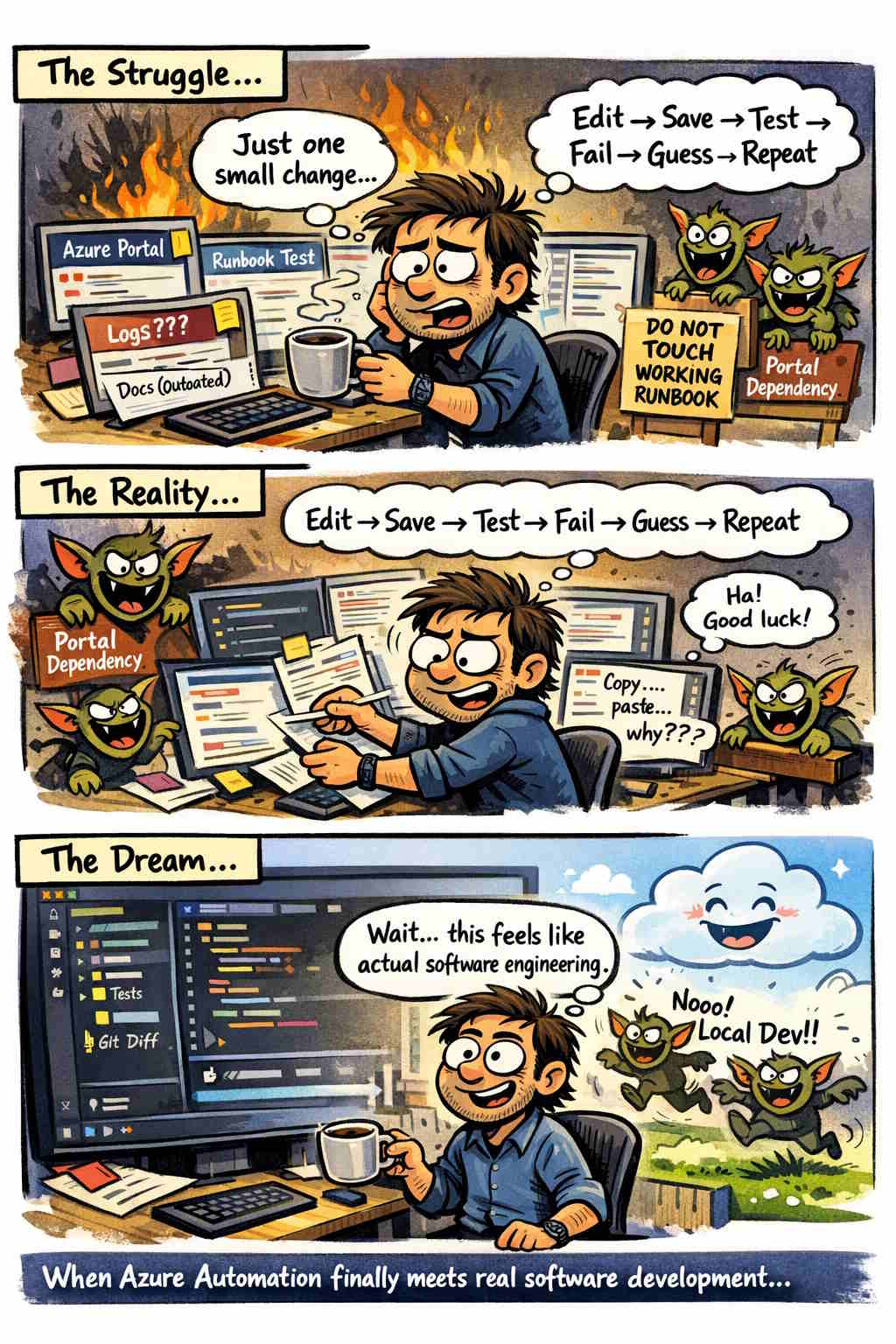
Anyone who has spent serious time with Azure Automation knows the story: too much back and forth, too much portal dependency, too much friction between authoring, testing, debugging, and deployment.
We end up stitching together folders, scripts, manual checks, and half-working approaches when what we really want is a proper development experience.
That gap has bothered me for a long time.
I wanted something that treats runbooks like real source code.
Something workspace-first. Something Azure-connected. Something that feels closer to modern software engineering and much less like trial and error in a browser tab.
That gap has bothered me for a long time.
I wanted something that treats runbooks like real source code.
Something workspace-first. Something Azure-connected. Something that feels closer to modern software engineering and much less like trial and error in a browser tab.
So I have been building toward that idea.
The goal is simple: make it easier to work locally, stay organized, validate changes with confidence, compare what is in source control against what is in Azure, and move from development to deployment in a way that feels natural.
It is being shaped for the people who want to:
- work with runbooks from a real local workspace
- fetch, edit, compare, and publish without unnecessary friction
- test locally with mocked assets
- debug properly
- keep things structured and repeatable
- prepare for CI/CD without turning every project into a custom puzzle
PowerShell is at the heart of it, because that is still where a lot of real-world Azure Automation work lives today.
But I also wanted to keep the door open for Python, because that story matters too and it deserves a better development experience than what we usually get.
This is not about making things flashy.
It is about making them practical. Reliable. Maintainable. Useful.
I am not ready to reveal everything just yet, but I can say this much: it is being built for the kind of workflow I always wished existed when working seriously with Azure Automation.
More soon.
See also
- ⚜️ Azure Runbook Workbench: A Better Way To Build Azure Automation Runbooks In VS Code
- ⚜️ Heading To MVP Summit 2026
- ⚜️ SharePoint Turns 25, And I’m Preparing Something New
- ⚜️ Speaking at ESPC25: Implementing SCIM for Multi-Tenant Identity Management in M365 and Azure
- ⚜️ Episode III of III - Setup your SPFx development in WSL2 ... with PnPWsl2 !